

Architecture
Centaur accepts Slack and API requests, stores each turn, assigns an isolated runtime, exposes approved tools, injects credentials through a proxy, and keeps an event trail clients can replay.
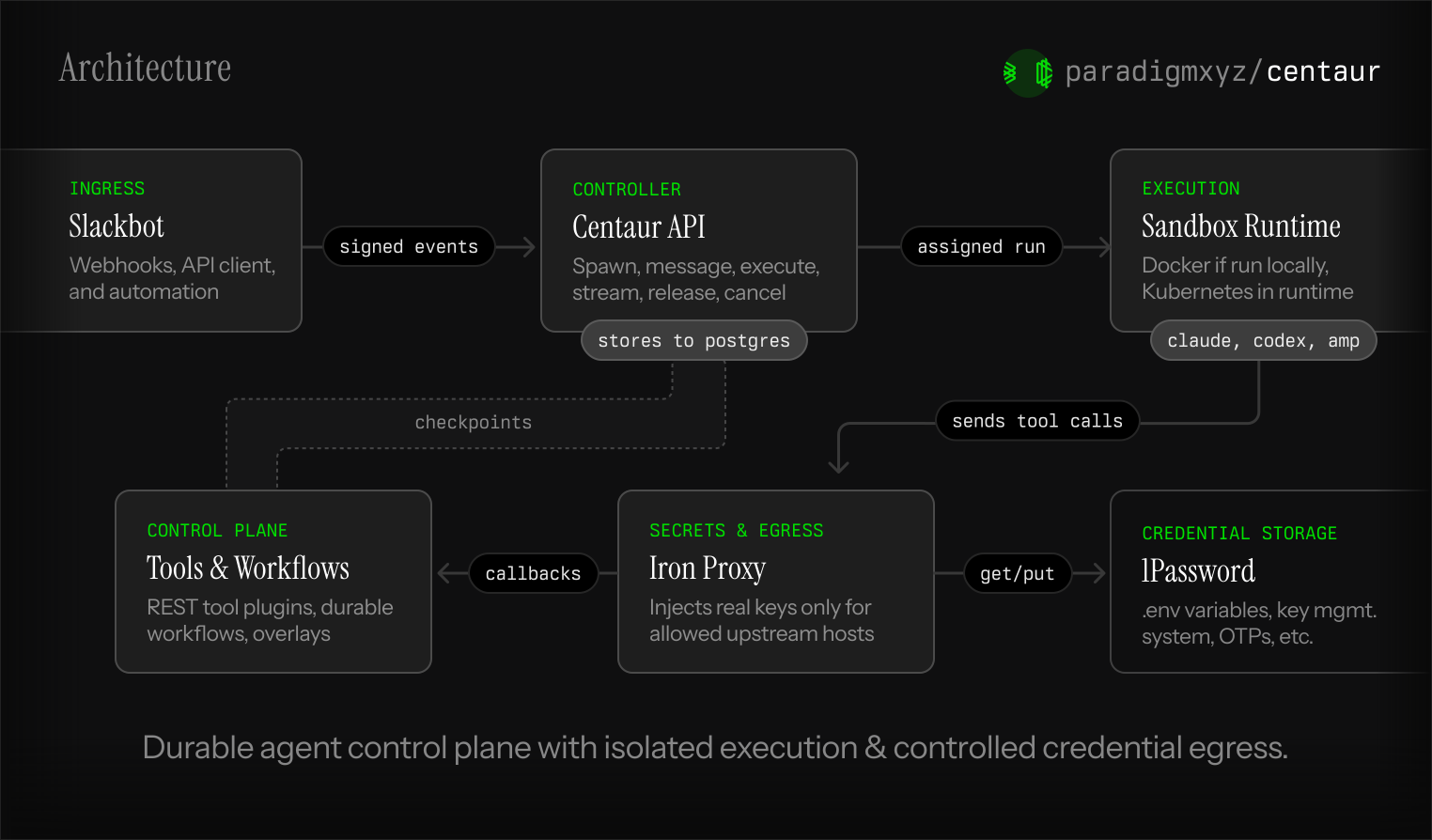
Planes
| Plane | Responsibility | Main components |
|---|---|---|
| Ingress | Accept user and client input. | Slack Events API, Slackbot webhook, external API clients. |
| Control | Persist requests and coordinate runtime state. | api-rs, Postgres, session runtime, workflow runtime. |
| Execution | Run one assigned agent session per thread. | Kubernetes sandbox pods. |
| Capabilities | Give agents approved actions. | Tool plugins, workflow engine, overlays. |
| Secrets and egress | Let agents call third-party APIs without receiving raw keys. | Kubernetes Secret, iron-proxy, per-sandbox proxy token mapping. |
Durable API lifecycle
Clients do not manage containers or keep long-running processes alive. They call the API and follow the event stream.
| Step | Endpoint | What it saves |
|---|---|---|
| Start or reuse a session | POST /api/session/{thread} | The thread's current sandbox assignment. |
| Persist input | POST /api/session/{thread}/messages | Writes one or more durable transcript messages. |
| Run the agent | POST /api/session/{thread}/execute | An execution row with status and final result events. |
| Follow output | GET /api/session/{thread}/events | Model output, status changes, and final text. |
Because each step is stored, a Slack reconnect, browser refresh, API restart,
pod replacement, or worker failover does not erase the run. The event stream is
the client contract; Slack and other clients should reconnect with
after_event_id instead of trying to reconstruct state locally.
Slackbot ingress
Slack talks to Centaur through the Slack Events API. The public request URL is the Slackbot webhook, usually:
https://api.acme.com/api/webhooks/slackThe webhook does not use a Centaur API key. Slack signs every request with
X-Slack-Signature and X-Slack-Request-Timestamp; the Slackbot validates that
HMAC signature with SLACK_SIGNING_SECRET before it routes the event to the API.
After validation, the Slackbot calls Centaur's api-rs session API with
SLACKBOT_API_KEY.
During a Slack delivery, the API owns the execution state while Slackbot owns Slack rendering: opening or updating the thread UI, streaming chunks, rendering steps, and posting the final answer. The landing page preview shows that Slack thread surface; the durable API lifecycle above is the system underneath it.
Execution path
Kubernetes is the active sandbox runtime path. The API creates or claims a sandbox pod, attaches to it, and runs the requested agent CLI. Do not plan a new deployment around a local-container backend; the Helm chart, warm pool, overlay mounting, and network policies all assume Kubernetes sandboxes.
| Harness | Adapter behavior |
|---|---|
| Amp | Materializes image/document blocks to files and passes text plus file references. |
| Claude Code | Passes the Anthropic-shaped content through directly. |
| Codex / pi-mono | Extracts text blocks for CLIs that accept a plain prompt. |
The pod receives the prompt files, CLI command, internal API URL, proxy CA, and proxy settings. It does not need Kubernetes credentials or long-lived third-party API keys.
Tool and workflow layer
Tools are Python plugin directories. api-rs discovers their metadata for
secret grants, while sandbox startup scans TOOL_DIRS for
pyproject.toml [project.scripts] and installs each script as a local CLI
shim. Agents discover tools with centaur-tools list, inspect one with
<tool> --help, and run the direct CLI.
Use tools for search, Slack, GitHub, market data, calendars, internal systems,
and deployment-specific APIs. Tool code should read credentials with
secret("NAME") so the same code works locally and in production.
Workflows are Python handlers run by services/workflow-python under the
api-rs Absurd workflow runtime. When a worker restarts, the handler runs again,
but ctx.step(...) returns cached results for completed work. Workflow
ctx.call_tool(...) remains available through the generated centaur-tools
compatibility bridge.
Use workflows for scheduled digests, monitoring loops, approval gates, jobs that sleep for minutes or days, and parent/child workflow trees.
Secrets and outbound requests
Agents and tools refer to credentials by name, such as OPENAI_API_KEY or
secret("CRM_API_TOKEN"). The sandbox container only ever holds those
placeholder names; the real values live on a per-sandbox
iron-proxy pod, bound to specific upstream hosts
and request locations, and substituted on the wire when an outbound
request matches.
See Security for the full threat model and what it does and does not protect against.
Failure model
| Failure | Expected recovery |
|---|---|
| Client disconnects | Reconnect to the event stream with after_event_id. |
| API restarts | Reload assignments, executions, and terminal state from Postgres. |
| Sandbox pod dies | The execution becomes terminal, the event trail remains in Postgres, and operators inspect GET /api/session/{thread} plus api-rs/sandbox logs before retrying the turn. |
| Workflow worker restarts | Re-run the handler and skip completed checkpoints. |
| Proxy restarts | Rebuild the key-injection map from the secret-manager cache. |
| Tool changes | api-rs reloads plugin metadata; new or refreshed sandboxes install updated CLI shims. |